

Summary
Discover how AI-powered marketing helps small businesses streamline tasks, improve customer targeting, and drive consistent growth. Learn practical ways to automate campaigns, gain real-time insights, and work smarter, not harder, to scale your business.

How Small and Medium Business (SMB) Owners and Marketing Professionals Can Use AI-Powered Marketing
On February 13, 2026, I had the privilege of presenting AI‑Powered Marketing for Small Business Growth: How to Work Smarter, Not Harder at The Marketing Summit 2026, produced by the Houston West Chamber of Commerce.

Photo courtesy: Genesis Photographers
The event brought together business owners, marketers and community leaders who are eager to understand how artificial intelligence (AI) can simplify their marketing efforts without sacrificing authenticity. This blog post expands on that presentation and offers a deeper look at how SMBs can use AI strategically, responsibly and confidently. Let’s dig in!
SMBs today face a unique challenge: marketing is more essential than ever, yet more overwhelming. According to industry data shared during the summit:
- 47% of small businesses say marketing is their primary strategy for growth.*
- 73% aren’t confident their current marketing strategy is working.*
That gap, between effort and clarity, is where AI can make a meaningful difference.
Most business owners aren’t struggling because they lack ideas or passion. They’re struggling because they lack time, bandwidth and a repeatable system. AI can help fill those gaps, but only when used intentionally.
What AI Is… and What It Isn’t
One of the biggest misconceptions about AI is that it’s here to replace people. That couldn’t be further from the truth. Don’t be afraid of AI or that it will take over your job or eliminate your business. Be afraid of the person who knows how to use AI in order to take the lead. Of course, that person could be you.
What AI is:
- Pattern recognition
- Prediction
- Automation
- A tool for accelerating repetitive tasks
- A way to surface insights faster
AI is not:
- A replacement for creativity
- A substitute for strategy
- A stand‑in for your brand voice
- A magic button that eliminates human judgment
AI is powerful, but it’s not a professional marketer. It’s a support system that helps you work smarter, not harder. When you use AI to enhance your creativity, not replace it, you get the best of both worlds: efficiency and authenticity.
AI Tools That Support Modern Marketing
During the presentation, we explored several categories of AI tools that small businesses can use right now—without needing a big budget or a technical background.
1. Content Creation: AI can help you draft social media posts, brainstorm blog topics, write email newsletters amd create outlines for long‑form content. The key is to treat AI as a first draft generator, not the final voice of your brand.
2. Market Research & Analytics: Instead of spending lengthy amounts of time and hefty budgets on research, consider using AI tools for things like summarizing customer reviews, identifying trending topics, analyzing competitor messaging and surfacing insights from large datasets. Speaking of complex sets of information, did you know that if you give an AI tool some metrics from Google Analytics, social platforms, email tools or CRM reports, it can translate them into:
- Trends
- Patterns
- Actionable recommendations
That’s right, you no longer have to look at your Google Analytics reports and not know what to do with the data. Using a tool like Microsoft Copilot® helps you make smarter decisions without spending hours digging through information or worse trapped in “analysis paralysis”.
3. Social Media Planning: I love using AI to suggest posting schedules, recommend hashtags, repurpose content across platforms, identify which posts perform best and recommend a call-to-action (CTA) that points readers to a relevant page on my website.
Using AI to plan your social media is especially helpful for small teams that need to stay consistent. I often start by drafting my own Facebook posts for the month ahead. Then I ask an AI writing tool to put those Facebook posts in a table that has next month’s dates in column 1, my Facebook posts spread out over the month in column 2. Then I ask AI to then generate similar posts for LinkedIn (column 3) and another set of posts for Instagram (column 4). I then ask AI to recommend graphics for each post and add those recommendations for column 5. This is a huge time saver, although I will continuously remind readers that they need to proof AI’s suggestions and add their personal touch to each. Below is one example of such a table that I used earlier this month. If you look at my Facebook post from 2/17/26 and peek at my LinkedIn post from the same date, and then compare that to the table below, you’ll see a lot of commonalities but not a pure copy and paste. While the Graphics Concept gives me ideas to consider using, I’m often go in an entirely different direction.
| Pub Date | Facebook Post | LinkedIn Post | Graphics Concept |
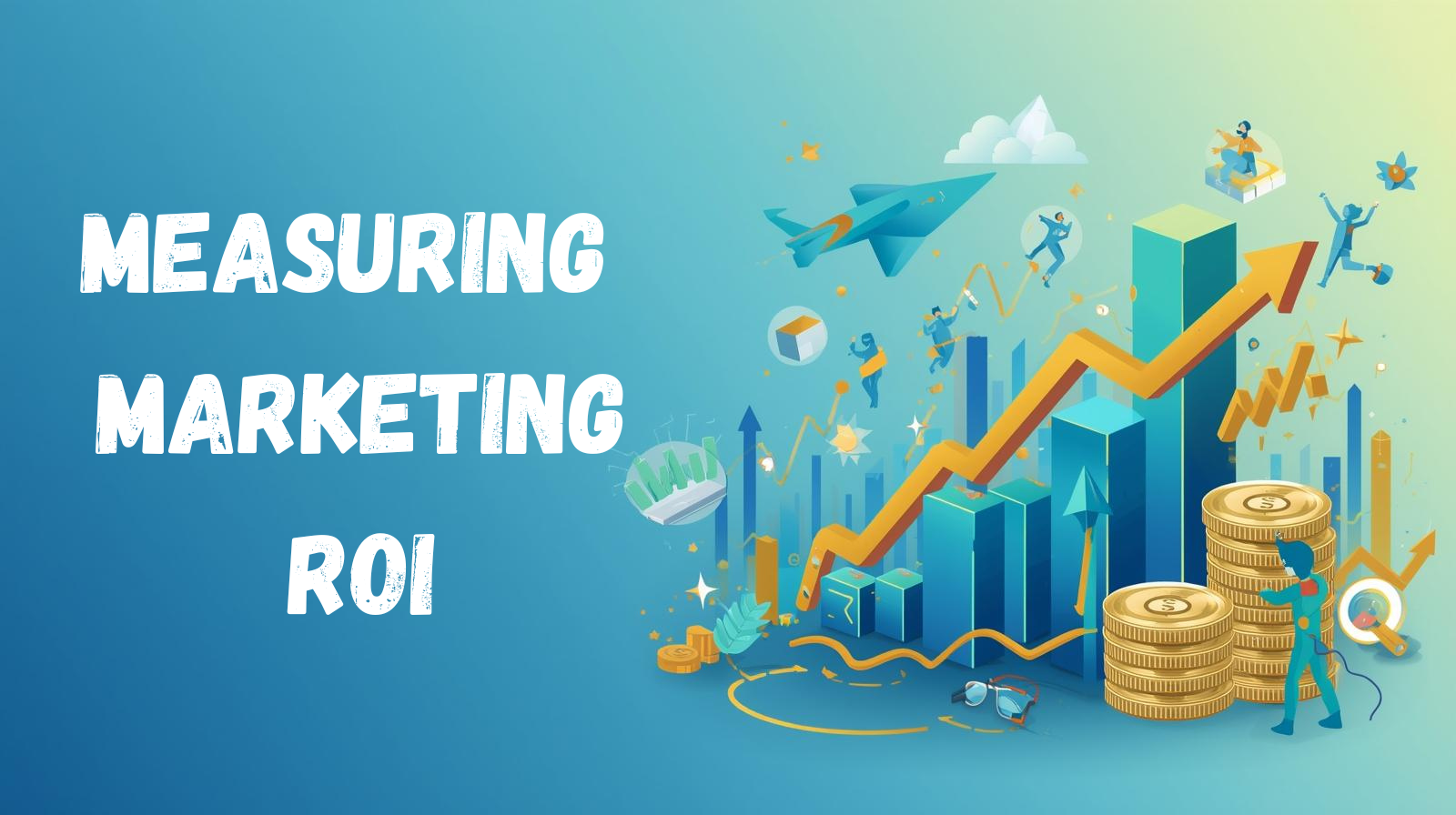
| Feb 17, 2026 | Measuring marketing ROI doesn’t require a big team or expensive tools. With the right framework, SMBs can track what’s working, refine campaigns & make smarter decisions. Start small, stay consistent and let the data guide your next move. #MarketingROI #SmallBusinessTips #MarketingAnalytics #HoustonSMB Get practical ROI tips at https://tellyourtale.com/blog/measure-marketing-roi/ | Proving marketing ROI is one of the biggest challenges for SMB leaders. But with a simple measurement plan, you can demonstrate value, optimize spend and align marketing with business goals. Data-driven decisions don’t require a full analytics department. Hashtags: #MarketingLeadership #ROI #BusinessGrowth #DataDrivenMarketing CTA: Read the ROI guide at https://tellyourtale.com/blog/measure-marketing-roi/ #SocialMediaBestPractices #SMBMarketing CTA: Read the full guide at https://tellyourtale.com/smart-photography-tips-for-social-media-success/ | Dashboard-style graphic with charts and KPIs. |
4. SEO Research: If you have website content that needs to be optimized, an AI assistant can help identify the keywords you should use on the back-end of each page. But don’t stop there. Take the recommended keywords and weave them into your web page’s visible content too. AI can also help analyze search intent, identify content gaps and recommend additional optimizations options.
So let’s look at how you can implement this right away. Looking at your Google Analytics reports for your website, you have a benchmark for how well or poor each page is performing. Use the keywords that AI suggests for one of your lower-performing pages. Weave those same keywords into the visible part of your web page. Publish and measure the success over the next few months to see if this particular page starts attracting better quality and improved quantity traffic. Of course, you need to review the recommendations here but AI helps you keep up.
A Real‑World Example: When AI Goes Wrong
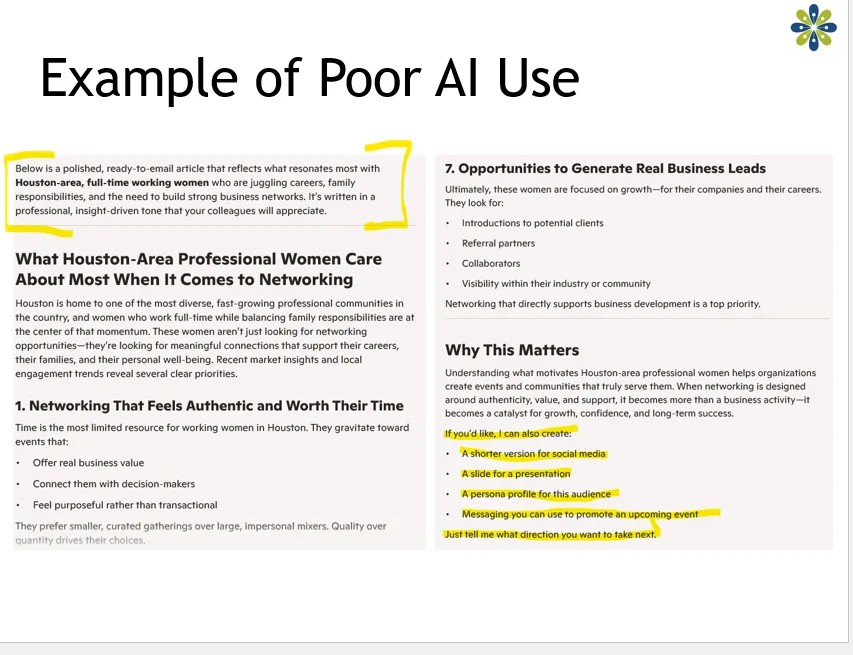
Shown below is a slide from my presentation that shows an example of poor AI use. AI is powerful, but it shouldn’t replace your strategic thinking. Here’s an example of what NOT to do.
I am the chairperson for a Chamber committee called Women Driving Business, which connects women business owners and top female professionals with each other in meaningful ways. I used Copilot® to generate ideas about what Houston professional women care about most when it comes to networking. Here’s the prompt I used: “What are the top interests of Houston-area women who work full-time, are balancing work & family, and need to network with others to generate business leads. Put the results in a short article that I can email to colleagues.”
Now, if I just copied and pasted the AI results (and a lot of people do just that & then post it to their blog), let’s look at what would be included. First, look at the introduction highlighted below on the left. Copilot® tees up its results with a recap of what you asked and what is being provided but my fellow committee members don’t need to see that.
Next, at the end of the results, you’ll see the recommendation on what else Copilot® can help with. See the below highlight on the bottom right. That’s great that this AI tool can put its results in a slide or create a shorter version for social media but I certainly don’t need to share that with my colleagues. When people share AI results with this info. included, it looks sloppy and unprofessional.
What’s more is all the content in between that needs to be reviewed by a human to see if it’s relevant to the topic and to your audience. Do you agree with that info? Do you disagree and want to delete some of this? What unique info can you add that showcases your perspective or expertise? The human touch is critical. Again, AI is only as good as the human guiding it.
Human fact checking of AI is also essential because AI can misinterpret context, invent facts, produce generic or inaccurate content, and miss the nuances of your brand. That’s why human fact‑checking is non‑negotiable. AI should never be allowed to publish content unchecked. Think of it as a junior assistant: helpful, fast, and eager, but not ready to run the show alone. Need further proof?
One freelancer was hired to author a list of summer book recommendations that would accompany another article about fun things to do in that city during the summer.** Unfortunately, the freelancer used AI to generate the recommended book list but didn’t fact check the content before submitting the list to the publication. Sadly, the editor didn’t fact check the book titles either and AI hallucinated book titles that do not exist. In fact, AI provided a list of real authors but books that haven’t ever been published. When readers complained, the publication apologized, saying it would no longer be working with that freelancer. I’ll go out on a limb to say that other publications likely followed suit. That’s a huge impact on a freelance writer’s career. While not fact checking AI results could impact your business differently, the effect can be negative all the same.
A Simple 40‑Minute Weekly Routine for AI-Powered Marketing
Here’s a 40‑minute weekly AI routine that business owners and marketing professionals can easily adopt. It’s designed specifically for those who want to stay consistent without feeling overwhelmed.
First step: 20 Minutes to Generate Content
Use AI to draft 3–5 social posts, create a blog outline, brainstorm email newsletter ideas and/or repurpose older content with an interesting, modern twist. This is your creative sprint.
Step 2: 10 Minutes to Review & Refine
This is where your expertise comes in. Adjust the tone of the content to align with your personal preferences. Add personal examples to give the content color and personalization. Verify the sources to ensure accuracy. AI gets you 70% of the way there. You finish the job.
Final step: 10 Minutes to Schedule Content
Use your preferred scheduling tool to load your social media posts, add visuals, insert hashtags and set posting times. Or tee up the email blast in a tool like MailChimp or Constant Contact. By batching your work, you work efficiently without adding more stress.
Turn One Idea Into a Week of Content
This framework is a game‑changer for small businesses. Start with just one idea discussed in this post. For example, use AI to draft a customer questionnaire. Research a product feature or brainstorm on a behind‑the‑scenes moment that might intrigue your prospects. Explore a common misconception or trend in your industry. Then use AI to turn that single idea into content you can use over the next week. Remember to be prescriptive in your prompt to AI and keep using the AI assistant so it can learn your tone and approach.
During my presentation, I asked for a volunteer to tell me about his customers’ pain points and how his business could address those pains. The volunteer ran a business that teaches swim lessons and we identified that the target audience was parents worried about their children who couldn’t yet swim. Here’s the prompt that we entered live into the AI tool: “Create a Facebook post, a LinkedIn post, a jazzy headline, a short email and blog outline about parents worried about their children who can’t swim. Help these parents learn more about swim lessons.” Appearing in less than a minute, the results were amazing and visible to the audience without my editing. Next, I asked the AI assistant to tailor the results a bit differently. Here’s the next prompt we used: “Take the above assets and customize them for a target audience of single moms in Houston or Katy who are super busy but are concerned about their kids’ safety.” The results gave this business owner more than a week’s worth of content to target a key buyer of his services. We also walked through the steps of tweaking that same content to address another ideal customer and received another campaign of marketing assets that could be used rather easily. One prompt becomes several days of content. This approach saves time, reduces decision fatigue and keeps your marketing full of fresh ideas.
Why AI Matters for Small Businesses
AI isn’t about replacing your marketing. I’s about making it more manageable. Small businesses often operate with limited staff, time and budgets. AI helps level the playing field by giving you access to tools that used to be available only to large companies. When used well, AI helps you:
- Stay visible
- Build trust
- Strengthen your brand
- Reach more customers
- Make smarter decisions
- Reduce overwhelm
It’s not about doing more marketing. It’s about doing marketing that works. Professionals who embrace AI thoughtfully will have a clear advantage. You don’t need to be a tech expert. You don’t need expensive software. You just need a willingness to experiment and a commitment to keeping your brand voice at the center.
The future of marketing isn’t human or AI. It’s human with AI. That’s a powerful combination.
If you’d like help building your own AI‑powered marketing routine or want support creating consistent, strategic content, Tell Your Tale Marketing & Design is here to help. Let’s work smarter together. Contact us today.
REFERENCES
* “35+ Statistics on Small Business Marketing to Know for 2026”, Sixth City Marketing, December 3, 2025. https://www.sixthcitymarketing.com/2025/12/03/small-business-marketing-stats/
** Mihalopoulos, Dan. “Syndicated content in Sun-Times special section included AI-generated misinformation”, Chicago Sun Times, Updated May 20, 2025, 9:17pm CST. https://chicago.suntimes.com/news/2025/05/20/syndicated-content-sunday-print-sun-times-ai-misinformation





Leave A Comment